Showing posts with label Ukraine. Show all posts

Saturday, March 25, 2017

Contrarian Signals (Or Why Romania May Be the World’s Best Performing Market This Year)

In my research and investing I stress three things: people, structure and value.  I look for companies that are controlled and managed by quality people, have corporate structures that align minority and majority shareholder interests and trade at valuations that are below fair value if not outright cheap.  This post is mostly about valuation and how bankers and financial experts take away the punch bowl just when an investment becomes attractive.  

I've written before how doing the opposite of what large financial institutions are doing and recommending can lead to higher returns (see here). This post is in the same vein . 
The reason I think Romania has a good chance of being one of, if not the best, performing stock markets this year is that the broker I use to access Eastern European stocks informed me that it will stop service there.  Earlier this year I had to transfer or sell all my Romanian shares.  To me, my broker’s closing operations is a large buy signal. 
The broker is ultimately owned by a large Belgian bank.  It’s likely that back in their corporate headquarters the stuffy-suited managers decided that all group companies would stop offering their clients access to Romanian equities.
This could likely be a very logical decision as it sounds like they have few clients trading Romania equities. My Prague-based account manager noted that I was one of four.
However, it is also short-sighted as there are many positives.  Romania has one of Europe’s fastest growing economies at 4.6% last year.  The country appears to be serious about political reform.   Its stock market is also one of the world’s better performing ones, having increased by close to 16% year-to-date. Despite the increase, many of its large cap stocks pay good dividends with yields north of 6%. 
While logical, it still stinks.  It took a long time to find a broker who provided access to most Eastern European markets and took US citizens as clients.  Part of the onboarding process was flying to the Czech Republic to sign account opening forms in person. (It was actually not much of a burden - Prague in June is actually quite nice.  But I’m still angry about it).
The situation reminds me of other instances where bank and financial product withdrawals and shutdowns turned into good contrarian signals. History doesn’t repeat, but it can rhyme, to paraphrase a famous quote. 
Consider the following:
  • Brazil – the EGShares Brazil Infrastructure ETF (BRXX) was closed and delisted at the end of October 2015.  At the time headline news in Brazil was pretty abysmal.  However Brazilian equities were starting to flash buy signals based on my screens.  Stocks in the BRXX were the least expensive among the handful of Brazilian ETFs.  Since its delisting, its top ten holdings have increased by an average of 64% in USD.  Many had good dividend yields which would have likely pushed total returns closer to 70%.  Not as good as the Bovespa’s 84% during the same time period, but not too shabby. (ETFs are like mutual funds that track a specific index or strategy and can be bought and sold like stocks.  More information is can be found here).
  • Greece - in 2012 HSBC sold its Greek securities business.  This was at the same time that I wanted to buy Greek shares, as they were trading at valuations similar to Korean stocks at the depths of the 1997/98 Asian financial crisis.  The bank that I’ve had an account with for almost 30 years took away a service just when I wanted to use it.  Over the next two years the headline Athex index rose by close to 200%.
  • Russia – in mid-December 2014 when the Ruble was floated and Russian securities and its currency plummeted, my European broker decided to suspend dealing in Moscow listed shares.  I was locked-out just when I wanted to buy.  Many share prices of quality companies I earmarked to buy are since up 2-3 times in USD.
  • South-East Asia – around 2001 HSBC closed and/or vastly curtailed its research operations in South-East Asia.  It was during this time that many of those markets started a multi-year bull run.  Since then, Indonesia’s and Thailand’s headline indexes are up by over 12x and 5x respectively in USD.
To be honest I really don’t know if Romania will do well this year.  Nobody does.  As I wrote in a previous post, the country’s stocks seem to be perennially cheap (see here).  Like all articles on investments, consider this article as an idea and interesting information, rather than advice. 
In addition to Romania, other Eastern European stock markets look attractive with several among the world’s best performing so far this year.  Czech stocks are some of the world’s least expensive. Polish stocks seem to be rebounding from political uncertainty since Poland’s late 2015 change in government.  And there’s even life in Ukrainian stocks as that country’s economy starts to stabilize.  Its GDP grew by 2.3% in 2016, rebounding from a 15% decline in the previous two-years. 
Index% Change Year-To-Date
(USD)
RomaniaBET14.7
PolandWIG19.4
Czech RepublicPX8.7
UkraineUX17.5

Bankers and their management are not known as visionaries.  They are known to stop lending and pull products when the market or economy is faltering and their clients need them the most.  This has happened before and it will happen again.  To me these are good, qualitative contrarian signals that are not easily programmable by the quants and algos.  Let’s call it ‘qualitative alpha’ or, my favorite, ‘Research Alpha’ (see here).

It doesn't look like I'll be part of the Romanian party unfortunately, but I hope there are some readers who can make some decent money on this.  Buy me a bottle of wine if you do. One from Transylvania will do nicely.


Thursday, January 5, 2017

Investment Confessional - Getting It Wrong In Ukraine

In my research and investing I stress three things: people, structure and value.  I look for companies that are controlled and managed by quality people, have corporate structures that align minority and majority shareholder interests and trade at valuations that are below fair value if not outright cheap.  This post touches on all three and is about one of my worst investments– at least so far

"We learn nothing from our winners", was how popular market commentator and interviewer extraordinaire Barry Ritholtz put it on a recent Masters in Business podcast (see here). I’ve read similar things in other investment books and articles.  It basically boils down to the fact that nobody's perfect and that it's best to learn from your mistakes.  Traders I know call it tuition.  We need to pay money (lose) in order to learn a skill.

Warren Buffet’s partner Charlie Munger, put it another way: “It's a good habit to trumpet your failures and be quiet about your successes".  This blog post is me tooting my own broken, bandaged, tail-in-between-my-legs, trombone. 

I wrote about Ukraine in two posts. They were based on my February 2014 trip to Kiev (see here and here).  I came away from my trip thinking that the uncertainty caused by the Ukraine/EuroMaidan Revolution marked an economic and stock market bottom.  This was not the case and both have fallen even further.

In mixed company and presentations I mostly blame the currency.  And numerically that accounts for most of my loss.  The Hryvnia declined by 67% vis-à-vis the USD since my initial investments in March 2014.  In contrast my portfolio of Ukrainian stocks is down about 50%.  The 17 percentage points of ‘alpha’ (or excess returns) is little solace when I’m down by half  at a time when other markets have risen.

However the currency decrease hides the fact that I made some real investment blunders.  The biggest mistake was not sticking to my investment process.  If I had, I would be wealthier and have slept much better.

Here is how I screwed up:

Inexpensive without quality is just plain cheap
I could see from my Hong Kong base that Ukrainian stocks were cheap on almost all traditional valuation metrics.  The key reason for the trip – indeed all trips - was to determine if the cheap stocks were of any value. 

It’s like buying clothes on the Internet. They may look like a bargain online, but if the size is wrong, the material cheap, and the stitching poor, it’s just plain cheap.  Cheap is the inexpensive shirt that hangs unused in your closet.  Value is the inexpensive shirt that makes you look good and feel confident. 

Moving from the cheap to value category is where my people and structure factors come into play.  Instead of sticking only to companies run by good people and have simple corporate structures, I invested in companies that were very inexpensive on many valuation measures, but were owned/controlled by people who are not likely to be good to minority shareholders.

One example is the country’s largest oil and gas company, Ukranafta.  It was jointly held by the government and the Privat group.  The Privat group is headed by Igor Kolomoyskyi, one of Ukraine’s richest men and an archetypical "oligarch", meaning he has both economic and political power.  He has a less-than-stellar-reputation according to Kiev locals who described him in much more colorful terms.  Despite this I thought that it being Ukraine’s largest energy company and its cheap valuation made it a good investment.  Its shares were at 3x EV/EBITDA when I bought it in early March 2014 (EV/EBITDA  is one of many financial ratios used in an attempt to value a company.  Generally a low ratio is preferable to a high ratio.  More information can be found here). 

Since then, the Privat group is believed to have stifled company reforms, blocked dividend payments, and transferred profits out of the listed company and into other group companies.  In March 2015 Kolomoyskyi used his privately-funded armed guards to defend against a "raider attack", after Ukraine’s parliament passed a law that took away Privat’s veto power at the company (see here).

The share price reflects a lot of these problems and is down some 80% in USD terms since I bought a stake.  Another way to look at this is that the same stock now has to increase five times for me to just break even. 

Sunk cost
Sunk cost is cost that has already been incurred and cannot be recovered.  In investments it typically refers to irrationally sticking with a stock that’s already gone down despite better choices.  If we have committed to something, our brain has a fierce resistance to believe it made a mistake and we are inclined to go down with the ship.

I stayed invested in Ukraine despite Russia taking over Crimea and a bloody war in Eastern Ukraine.  As a reminder, almost 10,000 have been killed and over 20,000 injured in Eastern Ukraine, which likely makes it the largest number of people killed in a European armed conflict since World War II. 

The old Rothschild attributed-adage, "buy when there’s blood in the streets", did not work.  After spending time and money going there, I felt I needed to recoup my investment.  It would have been better to cut my losses, and just think of my trip and expense as tuition.

In fact I increased my investments after elections were held in the Spring of 2014 and the person I thought would do a good job, Petro Poroshenko, was elected. 

Reputation / Pride
I was warned about the folly of buying Ukrainian stocks before I went.  This only increased my desire to go as I was told the same thing before I went to Greece the previous year.  My investments did very well there, with several more than doubling. 

Thinking like a trader rather than as an investor, I forced myself to buy stocks in companies I normally would not have, as all the market signs pointed to Ukraine as being the ultimate contrarian play. 

I thought I would look like a fool if I missed the boat in Ukraine after telling people I went there.  Instead I look like a fool now.  A poorer fool.

Listened to others instead of myself
Virtually all the financial people I met there were way too optimistic, especially after the end of the Maidan protests when local brokers really pushed Ukraine stocks.  Nobody expected the currency to fall so much despite it being very weak.

Only one investor – a very smart man from Minsk – correctly hypothesized that Russia would not let Kiev get closer to Europe without some sort of response.  Even an educational trip to the national museum where I learned that Ukraine was part of Russia for a long time and that it is essentially a Soviet creation, did not dissuade me.  Nor did an ex-military friend who correctly pointed out that there is no significant natural barrier between Ukraine and Russia.   Locals in Kiev – even those whose first language was Russian – were convinced Ukraine is clearly a European country and would soon be in the EU if not NATO.

Greed
Ukraine’s cheap prices and investment success in Greece the previous year made me greedy.  I remember sitting in my Kiev hotel room salivating at the low valuations of Ukrainian stocks.  But even low valuations don’t mean much if the quality is not there.

I essentially made things work in my mind.  I justified poor quality by thinking that at these valuations things can only get better, and put my blind faith in what brokers told me, rather than insisting on meeting management and doing my own work.

Lack of patience
Ukraine’s cheap valuations made it hard not to invest, and I did not wait for the currency to depreciate further.  I did not wait for poorly managed companies to work out their problems.  I did not keep money on the table to invest at lower prices.  Greed made me impatient.

Sticking around when one’s not wanted
Ukrainian companies are not investor friendly.  Only one locally-listed company wanted to meet.  It wasn’t just me; almost no companies were interested in meeting with investors.  Even the "blue-chips" were not investor friendly.

One of my worst ever meetings was with Ukraine’s largest pharmaceutical company.  “I don’t have to answer you!” was how the head of business development sternly put it when I asked pretty standard investor questions.  Even after explaining that I was already a small shareholder and I wanted to better know the company because I was thinking of increasing my stake, he must have thought I was engaging in corporate espionage.  When he found out I was not interested in buying products, he abruptly ended the meeting and cancelled the plant visit.

I should have sold immediately and taken the 10% loss.  Instead I waited and the shares are now down over 50%.

Some companies in Ukraine are shareholder friendly, and these seem to all be listed someplace else, mostly on the Warsaw and London stock exchanges.  Many have dedicated investor relations professionals who are keen to explain their companies.

Learning from one’s mistakes
While I've taken it on the chin, my Ukraine experience actually reinforces my belief that my investment strategy and process work.

One of the few companies I found that fits my people, structure and value model turned out to be my best investment there.  Kernel is a Warsaw-listed, Kiev-based agricultural company that is open to meetings, has good investor relations, a simple corporate structure and a solid owner/management that’s been buying shares.  Its valuation was higher than most Ukraine-listed companies, but it was certainly not expensive. Since then it’s started to pay dividends and its share price is up close to 60% in USD.

Hope springs eternal
I still hold my shares in the same handful of Ukrainian companies. Things are starting to look better for Ukraine so I’ll stick to my guns for the time being. Consider the following:

●      Widespread reforms. The European Commission calls Ukraine’s reforms unprecedented (see here).
●      Cleaning up the banks. A recent Financial Times article noted that cleaning up Ukraine’s banking system has been one of the country’s most successful reforms since the 2014 revolution.  Its central bank, The National Bank of Ukraine, has closed 80 out of 180 banks.  It’s too early to say that cleaning up the banks will lead to a positive credit cycle but it’s certainly a large step in the right direction (see here).  Just before Christmas government nationalized PrivatBank, the country’s largest, due to large scale-related-party lending.  PrivatBank is owned by two oligarchs, one of whom is the same Kolomoyskyi who controlled the oil company where I lost so much.  The authorities estimate that about 97% the bank’s corporate loan book was to parties related to its owners (see here). 
●      Clipping oligarch wings? Taking away two large assets from a powerful, well-connected (and many believed to be well-armed) oligarch is a bold move and a sign that government institutions could be growing stronger and, hopefully, fairer.
●      Return to growth. GDP grew in 2016 and is expected to increase by 2.3% in 2017.  Not rapid growth, but certainly better than the 6% and 10% respective decreases in 2014 and 2015 (see here).
●      Rising market. The UX, the country's main stock market index, is up over 40% in USD terms from its April 2016 low.  Stock market performance tends to precede economic performance.  One of the best performers during this time was Centranergo, the country’s largest listed utility.  Its share price more than doubled when it was announced that it will be privatized.
●      Geopolitical stalemate?  The eastern Ukrainian conflict seems to be a stalemate.  It could flare up again and remains a key risk.  But it seems to have reached some sort of ugly, unresolved détente.
●      Getting easier to do business.  Between 2014 and 2016 Ukraine climbed from the 152nd to the 80th position in the World Bank’s Doing Business Report. This was mostly under President Poroshenko’s leadership.  A businessman himself, he wants Ukraine to climb another 30 positions (see here).
●      Increasing tourism. Flights to Lviv are up 30% since last year.  I’ve not been there, but from what I’ve read it seems like the Kyoto of Ukraine with a modern yet traditional vibe (see here).
●      Improving companies? More importantly for equity investors, such as yours truly, Ukraine’s companies are showing some green shoots. 
■     The pharmaceutical company that refused to answer my questions joined the Ukraine Corporate Social Responsibility Development Centre in early December 2016; and brokers say one of their lenders is putting pressure on management to honor minority shareholder rights (see here).
■     The ex-oligarch-controlled oil company’s top management is all new since 2015, oil prices have increased, and Ukraine is determined to break its dependence on Russian energy.
●      Political stability for now. But has anything changed?  With nobody going to jail for past misdeeds one wonders if anybody in Ukraine has the power, will and means to clean up the system.  The next election has to be held before November 2019 so there will hopefully be some stability and further progress before domestic politics starts heating up (interesting article here).  

If anything this experience has made me believe in my process more.  My biggest mistake of all was deviating from my investment rules. If I had stuck to my simple focus of investing only in companies owned and run by good people, that have a structure that aligns majority and minority shareholder interests and that have value, I would not have made the many mistakes described above. 

One reason I now repeat the same first paragraph in all blog posts is to remind myself to focus on three things that matter – people, structure, and value.

It’s been a tough lesson.  Hopefully I’ve learned from my mistakes. 


Wednesday, April 15, 2015

It's A Chaotic World. Profit From It

In my research and investing I stress three things: people, structure and value.  I look for companies that are controlled and managed by quality people, have corporate structures that align minority and majority shareholder interests and trade at valuations that are below intrinsic levels if not outright cheap.

This post is mostly about people.  More specifically it is about investors and their desire for steady returns.  While I can understand the desire for predictability, it runs against my experience and philosophy.

Stability definitely has its place.  A stable political system, marriage and friendships are extremely good things.  And I’m about as far from an anarchist as possible.

But I feel differently about business and investments.  In fact I get scared when things are too stable and predictable.  The world is wonderfully chaotic and investors should embrace this rather than spending a lot of time, energy and money trying to smooth returns.  “Entropy is the only constant” is my favorite graffiti.  Closer to home friends say "變幻才是永恆"; "there is nothing permanent except change".  


Let me explain.

In the last few months I've been talking to people about my investment process and how I can help manage their funds.  It’s been going slow.  Most of the world is looking for steady, safe and predictable returns.  Asia’s moneyed class are looking for steady returns of 5-6% according to feedback from several in the financial community.

European investors must be even more scared.  Many are not only forgoing positive returns, but are paying governments for the privilege of holding their money.  Hence the negative government bond yields in many European countries. 

In contrast my investment strategy and process - which looks for out-of-favor quality companies in beaten down markets - are dependent on continued volatility.  Great bargains rarely appear in steady markets.  Great returns are also rare in steady markets. 


Be Afraid of Stability

Twenty-five years ago as a young analyst I loved analyzing companies that had steadily increasing sales, constant profit margins and growing profits. This made my financial projections easy. 

However experience has taught me not to trust steady returns and stability.  The business world is competitive and anything but stable.  I now believe that ‘stable’, ‘no risk’, and ‘guaranteed return’ are some of the most frightening words in business and investment.  

Consider the following:
  • Bernie Madoff’s funds got big by seemingly delivering steady monthly returns in both up and down markets.   As we know now, it was all a fraud.
  • Before it went bankrupt, Enron was well-liked by sell-side analysts and investors for meeting analyst estimates.  It steadily met expectations and was considered a stable and safe company.  But it was mostly smoke and mirrors before it became America’s largest bankruptcy. 
  • The desire for, and fallacy of, steady growth is nothing new.  Adam Smith (aka George Goodman) wrote about the illusion of steady growth in his 1972 book SuperMoney. "Everywhere you looked, there was a company with a neat stepladder of growing earnings.  Some kept the stepladder right up to the day they filed for bankruptcy" (my review of the book is here).
  • In his commentary on Dell being fined by the SEC for fraudulent accounting designed to smooth earnings, author and Darden School of Business professor Edward Hess notes that, "companies that grow for more than four consecutive years without resorting to earnings games are the exception, not the rule” (source document is here).
Growth and investments by definition are dependent on the future.  No one can predict the future so there is simply no way to fully guarantee their success or return.  Not every corporate expansion project works just as not every investment works (ask me about Ukraine. Link here).

At the end of the day, the world is not a stable or predictable place. And we don’t want it that way:
  • If the world was stable over the last 100 years most of us would be plowing fields and playing cards instead of working in temperature-controlled offices and surfing 100 cable channels.
  • Who would have predicted that a college dropout, hippy wannabe and a disheveled electronics geek would create Apple which changes the way we communicate, access information, and take pictures?
  • I’m sure Kodak and many other companies would have preferred the stability of the pre-digital world.  Investors who embraced change did well, those that stuck with the old did not
  • The biggest advertisement for positive effects of change is China.  Virtually the entire country has transformed in the last 30 years. Subsistence agriculture to export manufacturing to domestic consumption. Rural to urban migration. Collective agriculture to private property.  Etc, etc.
The world is wonderfully chaotic.  Live with it.  Embrace it.  Profit from it.


Saturday, May 17, 2014

Trip Report - Kiev, Ukraine; Feb 2014; Part I - Economy, Politics and A Bit of History

In planning my February 2014 trip to Kiev, I envisioned the Beatles' ‘Back in the USSR’, looping in my head as I visited companies, brokers and took in the odd tourist site.  

However I was there when the Maidan protesters were shot in central Kiev (13–22 February 2014) and the Talking Head's ‘Life During Wartime’ became the trip's soundtrack.   "A van, loaded with weapons, packed up and ready to go", is much more sobering and not nearly as much fun as “The Ukraine girls really knock me out.” 

Politics, Geopolitics, and a Bit of History

I’m not a big fan of politics.  Even less so of geopolitics.  But as this is being written in May 2014, Ukraine is front and centre in what seems like the beginnings of “Cold War 2.0” so politics is hard not to comment on.

Its eastern regions are holding referendums to break away, the press is writing that Ukraine may descend into  civil war, and Russian influence in the region seems apparent looking at pictures of the uniforms and flak jackets that pro-Russian protesters/soldiers are wearing.

Political uncertainty many times create good opportunities to invest in companies that may have been oversold. I've written a bit about this before (link here).  The Ukraine market had held up very well in the three months between when the Maidan protests started and I finally got my act together and went there. 

The Internet is flooded now with lots of writings about Ukraine, Russia, and how the EU and the US will react.  Most predictions will turn out to be false if the past is anything to go on (see Nate Silver's very good book The Signal and The Noise).  The article that best describes the situation after my week in Kiev was published by Quartz.com and can be found here.

I left Kiev with the impression that the West-East divide is not as serious as the press makes it out to be.  While most press reports – and most of the world – have escalated the Maidan protests and their aftermath into a Russia vs. the EU/US confrontation, I came away from my trip thinking that it was mostly a protest against 20-years of corrupt, power-hungry leaders of which Ukraine seems to have had more than its fair share of.  (for a better summary see here).  

A recent and very good Al Jezeera video report by Michael Anderson called Ukraine: A Dangerous Game added additional insight into the current situation.  The video references a (Ukraine) National University poll which indicates that in eastern Ukraine, less than 1 in 10 young people want eastern Ukraine to become part of Russia.  It also notes that most young people don't really care which language is spoken.  


He also believes that both Russian and EU/US journalists are irresponsible in the way they are reporting the current situation.  He notes that there is heavy propaganda in Eastern Ukraine that is stoking the conflict, and that most Western journalists are playing up a conflict that is not really there. 


My largest concern is that the democratic process was sidelined when Yanukovich lost his position and Ukraine moved form a presidential to parliamentary system.  It all happened in an extremely short period of time and seems too good to be true. I’m not really sure if it all went down by the book and the quickness may come back to haunt Ukraine in the future.  As I've written before, I think it is important for the process of democracy to be respected even if the current actors in that process are not great (link is here).

Brothers.  Another takeaway from the Kiev trip is that it will be hard for Russia and Ukraine to separate.  The two seem like the US and Canada; the US and Mexico; or Indonesia and Malaysia.  They are neighbors, speak the same language, more or less and share common histories and are amongst each other’s largest trading partners and investors.  I came away feeling that Ukrainians and Russians are basically brothers and sisters.

But I'm biased as I tend to see more similarities between people and nations than I do differences.  It is very likely that I am minimizing some fundamental differences.  As a CEO of an agricultural company I met in Kiev said, “Ukrainians are farmers. Russians are warriors”. 

Not to be forgotten is that siblings tend to fight the hardest. And the longest.  Protestant and Catholic Ireland, Sunni vs. Shia in the Middle East, North and South Vietnam, North and South Korea, America’s Civil War.  

However there is a lot of cross-border business that will keep the less politically involved Ukrainians and Russians interacting.  Some of this directly affects equity and bond investors.

This is because the largest shareholder of both financial exchanges in Kiev is the Government of Russia.  The Moscow Exchange owns 43% of the more equity-centric Ukrainian Exchange  (www.ux.us) and just over 50% of the more bond-centric PFTS (www.pfts.com).   The Moscow Exchange, is ultimately controlled by the Government of Russia through five entities the make up more than 50% of its ownership.  

Many companies that I met in Kiev either sell to or have investments in Russia.  Russians own controlling stakes in many Ukrainian listcos, and numerous Ukrainian listcos do significant business and have investments in Russia.

This includes the leading presidential candidate, Petro Poroshenko.  He owns Roshen, Eastern Europe’s fifth largest confectionery company.  In addition to Ukraine it has factories and outlets in Russia.  Sales of Roshen chocolates and other products were suspended in Russia for several months in 2013 with the reason suspected to be his political support for the Maidan protesters.  Earlier this year his factory in Lipetsk, Russia was closed down after it was taken over by riot police (link here).

Russia sometimes makes it hard for Ukraine to love it.  According to an insightful article in the International Edition of The Ukrainian Week by the very talented ex-buy-side analyst turned financial journalist Lyubomyr Shavalyuk, “Russia is proactively substituting (several) products with those made domestically and protecting its domestic market”.  The article points out that Russia has introduced many non-tariff trade barriers that effectively shut out many Ukrainian made goods that were previously exported to Russia. (For additional information on Russia, my review of the book Russians: The People Behind the Power, by Gregory Feifer is here)

This fact was brought home when meeting with an executive of a listed car manufacturer.  Soon after building a car factory, Russia changed some non-tariff regulations that effectively shut down Russia as an export market.  The new regulations were a way to protect Russian car makers at the expense of the new Ukrainian plant.  Now the plant is operating at some 20% of designed capacity and needless to say is losing money. 

Language. Some press articles have said that language is an issue between East and West Ukraine, but I think this is overplayed.  According to my hosts, all meetings in Kiev that weren't in English were in Russian.  My one word of Russian, "dos vidanya" or thank-you, was met with smiles from everybody I said it to; taxi drivers, hotel staff, CEOs/CFOs, etc.  

Stockbroker contacts in Kiev - two very proud Ukrainians - admitted that they never really speak Ukrainian - but they can understand it.  Others were proud of their native Russian heritage, but admitted they did not want to be part of Russia, and felt 'Ukrainian'.  This included a few that grew up and/or spent time in Kharkov and Donetsk, two of the larger cities in Eastern Ukraine that are pegged as pro-Russian.

Ukraine is in fact more than a bilingual place, which makes sense given its central location. In 2012 none other than Victor Yanukovich signed into law a ruling that regional languages will be recognized by the government if 10% of more of the total population of the region speaks it.  Soon after, Romanian became an official language in the Village of Bila Tserkva.  In addition to Russian and Romanian, Hungarian has been made a regional language in two regional towns (article here).

History.  There are two key takeaways from my trip to the National Museum of the History of Ukraine . I learned that modern and independent Ukraine has a very short history and virtually no period when it was not very close to or under Russia / USSR influence.  

Given its short history and the previous days’ discussion about Russia’s strategic interest in Ukraine, I left the museum feeling that there is a non-zero chance that Ukraine could break apart and/or the country could face a very nasty conflict or possibly war with Russia.

Modern Ukraine owns its very existence to Russia and the forming of the USSR.  A plaque in the sparsely visited museum noted that modern Ukraine only really came about in 1939 after being put together under the Russia led USSR.  

“In the second half of the 19th century and beginning of the 20th century Ukraine was split between parts of the Russian Empire and the Austrian-Hungarian Empire.”  “In the second half of the 19th century the Ukrainian national-liberation movement has gained momentum”.  (Source: Hall No. 15; Ukraine in the Second Half of the 19th century and the Beginning of the 20th century; National Historical Museum of Ukraine)  

“In September 1939, the Soviet Union annexed the Western Ukraine using the Molotov-Ribbentrop Pact.”  “Sovietization of western regions was realized with cruel methods and was attended by a mass repression. But the unification of all Ukrainian lands as members of the USSR was historically important.  For the first time in a few centuries of its history the Ukrainians lived in one state.” (Source: Hall No. 26; Ukraine During the Second World War (1939-1945), National Historical Museum of Ukraine)  

Source:
National Historical Museum of Ukraine
Hall No. 26
Source:
National Historical Museum of Ukraine
Hall No. 15
There is some historical baggage between the Ukraine and Russia.  From the museum trip I learned about the 1932-33 man-made famine which occurred in many of the USSR’s agricultural areas.  Ukraine was the hardest hit.  Like China’s 1958-61 Great Leap Forward, many historians believe that forced collectivization of agriculture was the key reason in which an estimated 6-8 million people starved. 

Called the "Holodomor" in Ukraine one estimate puts the total loss in Ukraine alone at 10m - 4m from famine and 6m from birth defects. (see Wikipedia entry on the “Holodomor”).  Several Internet websites claim that it was a genocide perpetuated on Ukrainian agricultural peasants by the USSR.  (More information and gruesome pictures and video can be found using a Google search on “Holodomor".)

(See link here for a more complete, and more critical, history of modern Ukraine – especially under Nazi Germany and the USSR.)

Economy

From my trip, I was told that Ukraine's economy never really recovered from the global financial crisis and that it has been stagnating for years.  

This is very evident in comparison with their western-bordered neighbor Poland.  In 1991, about the time the iron curtain fell, Poland’s per capita GDP was 47% higher than in Ukraine's.  It is now more than 3x higher. 

People living in eastern Ukraine may be making the same point but using Russia as a base for their comparison.  Per capita GDP has not grown as much in Russia as in Poland, but is still almost double Ukraine's over the last 20-years.

Ukraine’s slow growth also stands in sharp contrast to countries in my neck of the woods.  Twenty years ago the average Ukrainian was more than 3x richer than the average citizen of Mainland China.  Now he/she produces almost half as much.

On a GDP per capita basis the average Ukrainian is now on par with the average Indonesian.  But their lifestyle is not likely as good as people who live near the equator don't have to worry about staying warm in the harsh northern European winter. 


GDP/Capita 2012
GDP/Capita 1991
% change
Ukraine
         3,867
         1,490
        159
Poland
       12,710
         2,187
        481
Russia
       14,037
         3,427
        309
Indonesia
         3,471
            705
        392
China
         6,091
            330
     1,745


Source: World Bank; GDP/Capita (at current USD)

As in other under performing economies, poor leadership seems to be the root of the problem.  Locals complain that the country has a lot of positives but has been led by people who are more interested in taking what they can from their powerful positions, rather than strengthening the government, institutions and infrastructure that Ukraine and its people need.

Widespread corruption, a compromised judiciary, and weak legal property protection add to the long list of problems. (More information about Ukraine’s corruption and economic problems can be found here).

Another big problem is that nearly half of Ukraine’s GDP is generated by imported energy-intensive industries.  Ukraine depends on subsidised energy imported from Russia as it is only 7% self-sufficient in oil and 40% in gas according to local brokers. The situation is rapidly changing and Ukraine can no longer depend on this going forward.  

Ukraine does have quite a lot of things going for it.  Its legendary ‘black soil’ gives it a natural competitive advantage in agriculture.  According to one Kiev-based broker, it is the second largest country in Europe by size with 15% of the continent’s arable land.  It is the world’s sixth largest exporter of grains (excluding rice) with most of this heading to the Middle East and Northern Africa.  It is the largest global supplier of sunflower oil and one of its largest exporters of walnuts.

It also has industry.  Ukraine is one of the key producers of railway cars in the CIS. It also has one of the largest aviation engine manufacturers in the CIS and is the center of the former USSR's aviation industry.  It supplies engines to 90% of helicopters produced by Russia.

It can also develop talent locally.  Many graduates from Kharkov’s top universities end up in Silicon Valley and other tech centers much like smart graduates from India’s famous technical universities. Only a few of the people I met in Kiev had studied abroad, but almost everybody I met spoke some if not very good English.  

I met many switched-on and forward-thinking people during my 10-days in Kiev.  I was especially impressed with those below 40 who likely grew-up in a freer environment than their communist / Soviet-thinking parents and grandparents.

In a very encouraging sign, Ukraine was listed as the world’s top reformer in the World Bank's 2012/13 Doing Business report. This report ranks countries by their support for laws that favor small and medium businesses. It praised Ukraine for implementing more pro-small and medium business reforms than any other country.  These include making it easier to start a business, dealing with construction permits, strengthening property rights, and improving credit information available to collectors and debtors. 


Travel notes

Kiev reminded me of my native DC.  The wide Dnieper river runs through the center of the city, there are lots of trees and not many tall buildings.  

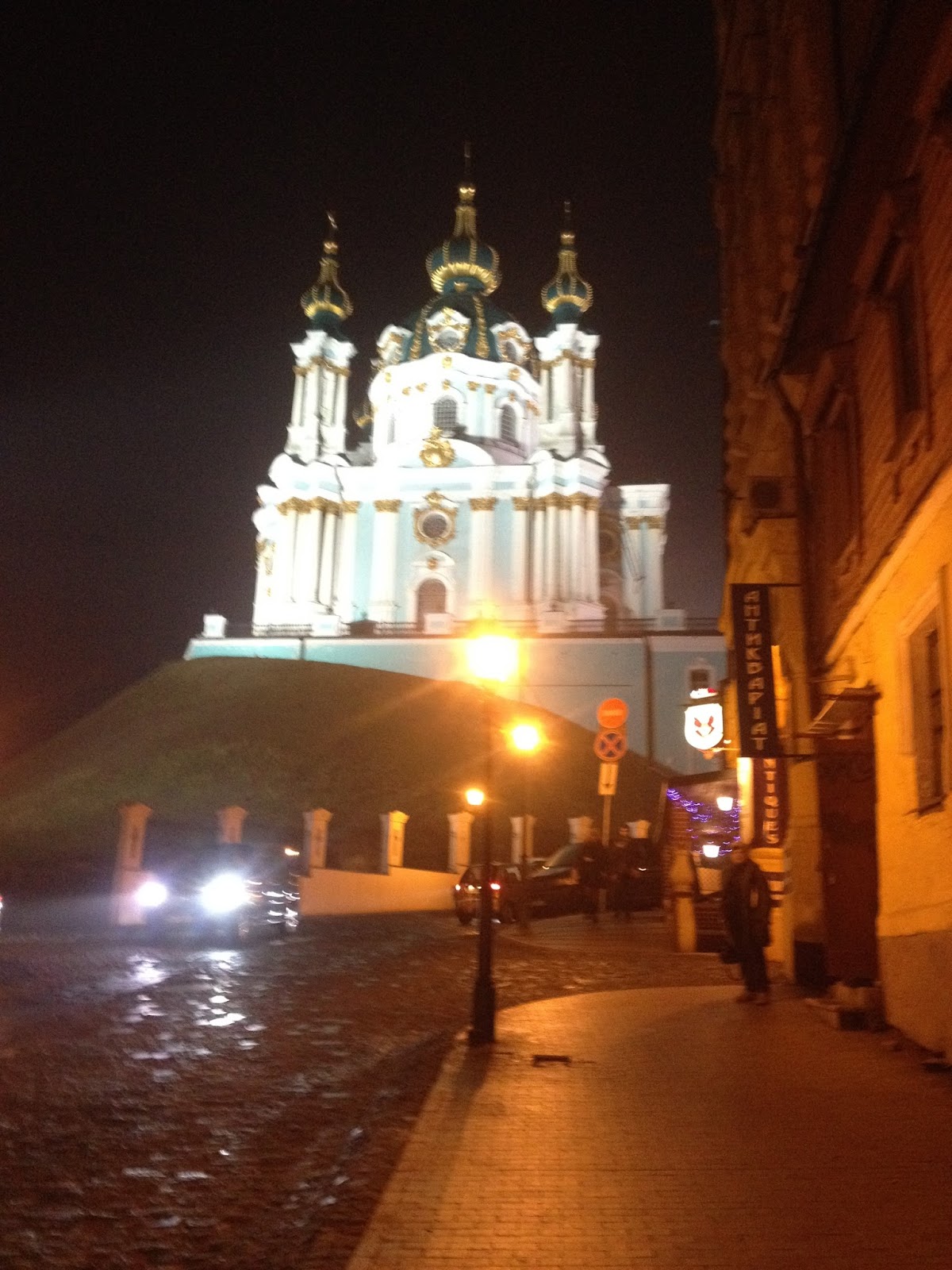
There is also a lot to see.  Very impressive orthodox churches, national museums, and many historical tourist sites.  Kiev was the origin of the Russian culture and the city takes pride in this fact. 


It must be beautiful in May, when the locals say is the best month to come.  I was there in mid-February and had a very pleasant, albeit overcast and cold, weekend playing tourist.


Kiev's road system seemed like DC when I was growing up.  Roads are good and traffic seemed to flow most days, but I did experience a few very serious traffic jams and lots of potholes.  

The city has lots of cafes and prices are reasonable.  The menu selection can be eclectic though. Several restaurants have Japanese, Italian and Mexican on the same menu and likely cooked by the same chef. Lovers of spicy food may not be too impressed, but if picked vegetables, chicken and a good beer selection is your thing, you’ll probably like Kiev. 


Good Beer Selection
Roadside Market, Outside Central Kiev
Feb 2014 

Despite being there during the same week as the Maidan shootings, I never felt unsafe.  All the action took place in central Kiev.  Everyplace else I went seemed peaceful, although my contacts were concerned about my and their own safety.  After the Maidan shootings, I was told that Russians and Eastern Ukrainians thugs were travelling or already in Kiev.  These don't seem to have been substantiated as I did not hear of anything violent outside the city centre. 

I was obviously unlucky with my timing. Meetings on two of the six weekdays I was there were basically cancelled when the subway was shut and bridges into the city were closed.  On those days, staff went home early or worked from home.

Despite it being possibly one of the most important weeks in the country’s history, I was just plain bored.  With meetings cancelled and not wanting to get involved in a domestic dispute I watched all  of the action from my hotel room with walks to the restaurants and grocery store breaking up the day.

Lastly, despite the chill of winter, lack of sunshine and gloomy political mood I found that the people I met are smart, proud of their country and city, and keen to see Ukraine 'reboot' and move forward.  While outsiders seen Ukraine as a country torn between Western Europe and Russia, many people I met also saw this as an advantage as it has large markets at its doorstep and is a traditional bridge between Russian and the rest of Europe. 

On my last full day in Kiev violence in the square had stopped, the sun had broken through the clouds and I had a full day of meetings.  The last was with one of the smartest - and certainly best looking - CEOs I've ever met.  It was refreshing to get back to business.   


“The Ukraine girls really knock me out" was finally ringing in my head.